
Beyond CRISPR: How Reprogramming a Native Human Protein Could Unlock the Future of RNA Medicine
Contents
Reading Time: ~8 minutes
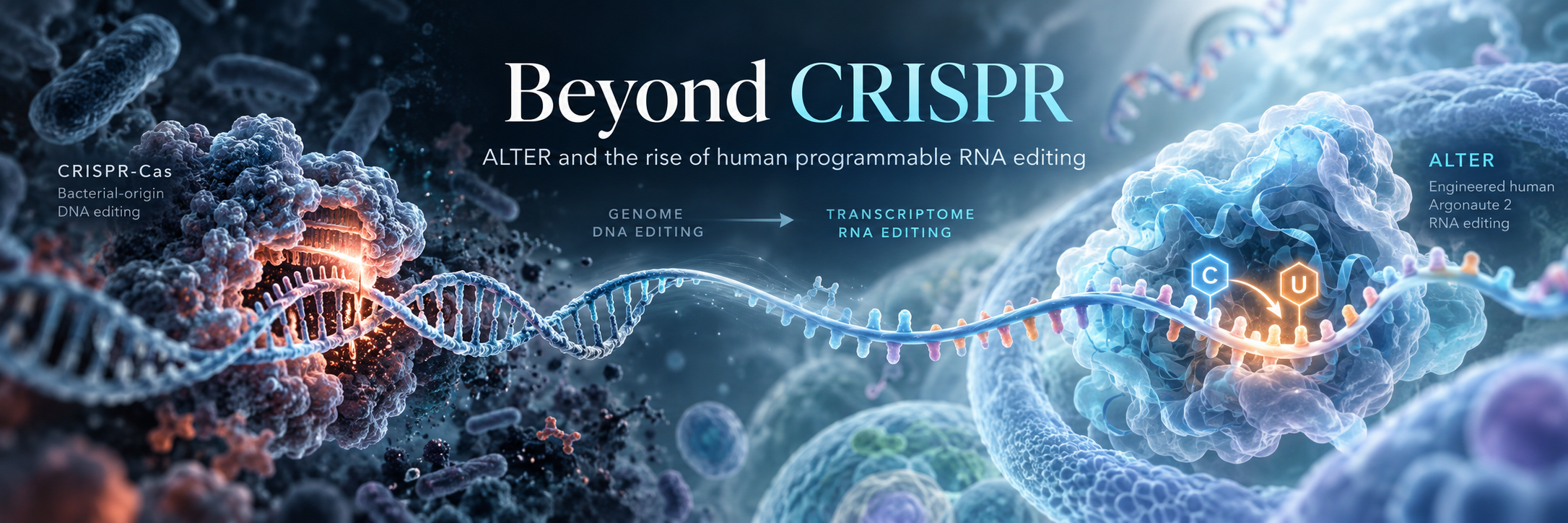
For the past decade, the story of programmable medicine has been dominated by a single family of molecular machines: CRISPR-Cas. Originally borrowed from the adaptive immune systems of bacteria, Cas proteins—like DNA-cutting Cas9 and RNA-targeting Cas13—gave humanity a programmable GPS for the genome and transcriptome.
Yet as CRISPR therapies transition from laboratory petri dishes into human clinical trials, a fundamental biological friction has emerged: our bodies do not like bacterial proteins.
In a landmark study published in Nature Biotechnology (“Engineered human Argonaute 2 for targeted C-to-U RNA base editing”, DOI: 10.1038/s41587-026-03359-y), a team of researchers at Stanford University led by Robert F. Lusi, Salvador Moncayo von Hase, Corey Model, and Steven M. Banik asks a provocative question: Why import foreign bacterial machinery into human cells when evolution has already built a superior RNA-targeting engine inside us?
Their answer is ALTER (AGO-led targeted editing of RNA)—a programmable C-to-U RNA base editor built entirely from engineered human proteins. By teaching a well-known human protein a brand-new trick, ALTER doesn’t just match bacterial Cas13 editors; it outperforms them in efficiency, dramatically lowers off-target noise, and paves a realistic pathway toward repeatable, non-immunogenic RNA therapeutics.
The Bottleneck: Why RNA Medicine Needs a Post-CRISPR Upgrade
Before diving into the future applications of ALTER, it helps to understand why editing RNA (rather than DNA) is so appealing—and why current tools have hit a wall.
DNA base editing permanently alters a cell’s hard drive. While permanent fixes are ideal for certain monogenic inherited diseases, an off-target DNA edit is irreversible and carries lifelong oncogenic risks. RNA editing, by contrast, modifies the transient mRNA “software” transcripts. Because mRNA naturally turns over within hours or days, RNA edits are temporary, reversible, and tunable.
However, that exact feature—RNA turnover—creates a massive hurdle for Cas13-based RNA editors (such as RESCUE and CURE):
- The Repeat-Dosing Immune Trap: Because mRNA constantly degrades, patients with chronic conditions require repeat dosing. Delivering a foreign prokaryotic protein like Cas13 repeatedly triggers the human adaptive immune system, leading to neutralizing antibodies and cytotoxic T-cell responses that wipe out therapeutic efficacy.
- Delivery Size Limits: Cas13 proteins are bulky, making them notoriously difficult to package into single Adeno-Associated Virus (AAV) vectors, which have a strict ~5-kb payload ceiling.
- Suboptimal Kinetics & Collateral Damage: Bacterial Cas13 did not evolve in a mammalian cellular environment. It searches and binds RNA targets more slowly and with lower affinity than mammalian RNA-binding proteins, and can cause unintended collateral RNA cleavage or erratic interactions with host regulatory networks.
Enter ALTER: Hijacking Human Argonaute 2
Every human cell already possesses a master of RNA surveillance: Argonaute 2 (AGO2), the catalytic engine of the RNA interference (RNAi) pathway. Loaded with a tiny 21-nucleotide small interfering RNA (siRNA) or microRNA (miRNA), AGO2 rapidly samples the cellular transcriptome, pierces through complex secondary structures, and binds matching mRNAs with extraordinary speed and affinity—far surpassing Cas13.
Normally, when AGO2 finds a full match, it slices the mRNA in half to silence the gene. The Stanford team realized they could repurpose AGO2 from an RNA destroyer into a modular RNA targeting domain.
How the Molecular Engineering Works:
- The Human Fusion: They fused human AGO2 to human APOBEC3A (A3A), a cytidine deaminase enzyme that chemically converts Cytidine (C) into Uridine (U) on single-stranded RNA.
- The “Loop-Inducing” Guide RNA Trick: For AGO2 to slice a target, bases g9–g12 in the center of the guide RNA must pair perfectly with the target mRNA. The researchers designed 21-nt guides (such as
14L8(11,10)) that clamp tightly onto the target RNA on both flanks (the 5’ seed and 3’ supplementary regions) but force a 14-nucleotide single-stranded RNA loop to bulge out right in the middle. This accomplishes two things at once: it shuts off AGO2’s slicing activity (preventing mRNA knockdown) and pushes the target Cytidine out into an exposed stem-loop—the exact 3D structural conformation that A3A loves to edit! - Rational Protein Optimization & AI Deimmunization: Through systematic mutational screening (creating variants ALTER-1 through ALTER-5), the team introduced specific point mutations into AGO2 (
F470V;F505V;Q633R) and A3A (K30R;Y132G). The resulting ALTER-4 achieved 1.9-fold higher C-to-U editing across endogenous mRNAs compared to Cas13 editors (CURE-N and RESCUE-S), with up to 4-fold to 25-fold fewer transcriptome-wide off-targets when dose-normalized. Even better, using the deep-learning MHC-II presentation model MARIA, they discovered they could delete the artificial peptide linker entirely—relying on AGO2’s naturally flexible N-terminal tail—and make two minor tweaks (M1C,Y2W) to eliminate virtually all predicted immunogenic peptides.
| Feature / Metric | Cas13 Editors (CURE-N / RESCUE-S) | ALTER System (ALTER-4 / ALTER-5) |
|---|---|---|
| Protein Origin | Bacterial (PspCas13b / RanCas13b) | Fully Human (Engineered AGO2 + APOBEC) |
| On-Target Efficiency | Baseline reference | 1.9-fold higher on average across endogenous mRNA targets (PPIB, SMARCA4, ACTB, TYMS), and 3-fold higher than RESCUE-S on reporter assays. |
| Transcriptome Off-Targets | ~1,930 to 2,050 C-to-U/A-to-I off-targets (plus >1,100 A-to-I off-targets for RESCUE-S) | 518 off-targets (for PPIB, 4x lower). Lowering the dose to match Cas13 efficiency caused a 25-fold drop in off-targets (down to 116). Zero A-to-I off-target issue. |
| Immune Risk (MHC-II) | ~370–400 immunogenic peptides predicted | Near-zero after AI-guided deimmunization. |
| Clinical Delivery | Challenging due to large size of Cas13 | Packaged and delivered via single-vector AAVs and Virus-Like Particles (VLPs) as ribonucleoproteins (RNPs). |
Future Applications: Where Will ALTER Transform Medicine and Biotech?
While ALTER is currently validated in human cell models (HEK293T), its architecture solves the most stubborn roadblocks in clinical translation. Here are the six major frontiers where AGO2-led RNA editing is poised to make an impact.
1. Chronic Genetic Diseases Requiring Lifelong Repeat Dosing
Thousands of human genetic disorders are caused by pathogenic T-to-C point mutations in DNA (which transcribe into faulty C bases on mRNA instead of U). Examples span metabolic liver disorders, cystic fibrosis variants, neurological channelopathies, and inherited retinal dystrophies.
Because ALTER is built from native human proteins and deimmunized via machine learning, the human immune system is far less likely to mount a CD4+ T-cell response against it (~380–400 immunogenic MHC-II peptides in Cas13 vs. near-zero in deimmunized ALTER-4M). This opens the door to chronic, repeat-dose RNA base editing—allowing patients to receive periodic infusions of an RNA editor much like a standard biologic drug, correcting pathogenic proteins without ever cutting their genomic DNA.
2. Piggybacking on the Multi-Billion-Dollar siRNA Drug Pipeline
One of the most exciting practical advantages of ALTER is that its targeting system uses standard 21-nucleotide small RNAs. Over the past 20 years, the pharmaceutical industry (led by companies like Alnylam) has invested billions of dollars perfecting the chemical modification (2’-O-methyl, phosphorothioate backbones, GalNAc conjugates) and clinical delivery of synthetic siRNAs.
The paper demonstrates that ALTER works seamlessly when fed exogenous siRNA duplexes. In the future, a patient’s target tissue (such as the liver or central nervous system) could express a stable, dormant ALTER chassis, while clinicians administer off-the-shelf, chemically stabilized synthetic siRNA guides to turn editing on, dial the dosage up or down, or switch targets on demand.
3. Transient “Hit-and-Run” Therapeutics (Pain, Inflammation, & Tissue Regeneration)
There are many clinical scenarios where you never want to permanently alter a patient’s DNA—such as modulating acute organ injury, accelerating wound healing, temporarily rewiring immune checkpoints in oncology, or modifying ion channels for non-opioid pain management.
By delivering ALTER via Virus-Like Particles (VLPs) as pre-assembled ribonucleoprotein (RNP) complexes—a feat the authors successfully demonstrated in the paper—clinicians could execute “hit-and-run” C-to-U edits. For instance, C-to-U editing can transiently erase a phosphorylation site on a signaling protein, modify protein-protein interaction interfaces, or introduce a temporary premature stop codon (CAA/CAG/CGA to UAA/UAG/UGA) to dial down a toxic pathway for a few days before the cell naturally resets.
4. Expanding the Editable Transcriptome (Beyond UC to GC and AC)
Wild-type human APOBEC3A strictly prefers editing cytidines preceded by a uridine (UC sequence motif). If a patient’s disease mutation sits in a GC or AC sequence context, standard A3A editors are blind to it.
By demonstrating ALTER-5—which swaps in a chimeric deaminase domain (A3A(ddA1), grafting the deaminase domain of APOBEC1 into A3A)—the authors proved that the AGO2 scaffold can forcefully edit endogenous GC and AC targets at rates far exceeding Cas13-based RESCUE-S, without suffering from RESCUE’s >1,100 off-target A-to-I edits. Furthermore, by appending a nuclear localization sequence (ALTER-4N), the system can enter the cell nucleus to edit nuclear long non-coding RNAs (lncRNAs) like MALAT1, opening applications in nuclear RNA disorders and splicing diseases.
5. Single-Vector Gene Therapies & Miniaturized Payloads
Clinical gene therapy relies heavily on AAV vectors, which struggle to fit large Cas13 fusions alongside their promoters and guide RNA cassettes. The authors not only proved that full-length ALTER-4 + guide RNA fits and functions inside a single AAV vector, but they also discovered ALTER-3 (AGO2-deltaPAZ)—a rational truncation that deletes 127 amino acids (the entire PAZ domain of AGO2) while doubling the editing signal and lowering background noise. This compact footprint gives gene therapy engineers valuable breathing room to add tissue-specific promoters or regulatory switches inside a single viral capsid.
6. A Universal “Plug-and-Play” Human Epitranscriptomic Platform
Perhaps the grandest implication of this paper lies in a single phrase from the abstract: repurposing AGO2 as a “modular RNA targeting domain”.
C-to-U base editing is only the first proof of concept. Because the loop-inducing guide RNA turns AGO2 into a programmable, non-cleaving RNA binder, bioengineers can now unbolt the APOBEC deaminase and fuse AGO2 to an entire catalog of other human effector domains:
- A-to-I Base Editors: Fusing human ADAR deaminase domains for clean, human-scaffolded Adenosine-to-Inosine editing.
- Epitranscriptomic Writers & Erasers: Fusing human methyltransferases (like METTL3/METTL14) or demethylases (like ALKBH5) to write or erase m6A RNA modifications on specific transcripts.
- Splicing & Translation Modulators: Fusing human splicing factors to rescue exon-skipping diseases (like Spinal Muscular Atrophy or Duchenne Muscular Dystrophy), or translation initiation factors to selectively boost protein production from haploinsufficient genes.
The Road Ahead: Challenges to Watch
While ALTER represents a major leap forward, a few engineering puzzles remain before it enters the clinic:
- Differentially Expressed Genes (DEGs): Because AGO2 is an endogenous hub of the human RNAi pathway, overexpressing an engineered AGO2 construct caused a higher number of differentially expressed genes than bacterial Cas13 (though GSEA pathway analysis showed no systemic dysregulation of the native miRNA regulome). Future iterations will likely refine AGO2 mutations to completely insulate ALTER from native cellular binding partners.
- High-Throughput Guide Rules: The authors noticed that the optimal loop geometry (e.g.,
14L8vs.12L6) varies depending on the local sequence and secondary structure of the target mRNA. Building machine-learning models trained on massively parallel guide screens will be essential to predict the best loop-inducing guide for any human gene.
Final Thoughts
For years, synthetic biology operated under the assumption that to control mammalian cells, we had to borrow molecular tools from bacteria and force them to work in humans. With ALTER, the Banik lab at Stanford has flipped the script—showing that by combining deep structural knowledge of human RNAi with rational protein engineering and AI-guided deimmunization, we can build safer, faster, and more potent molecular medicines using the parts our own cells already trust.
Reference:
Lusi, R. F., Moncayo von Hase, S., Model, C. & Banik, S. M. Engineered human Argonaute 2 for targeted C-to-U RNA base editing. Nature Biotechnology (2026). https://doi.org/10.1038/s41587-026-03359-y